
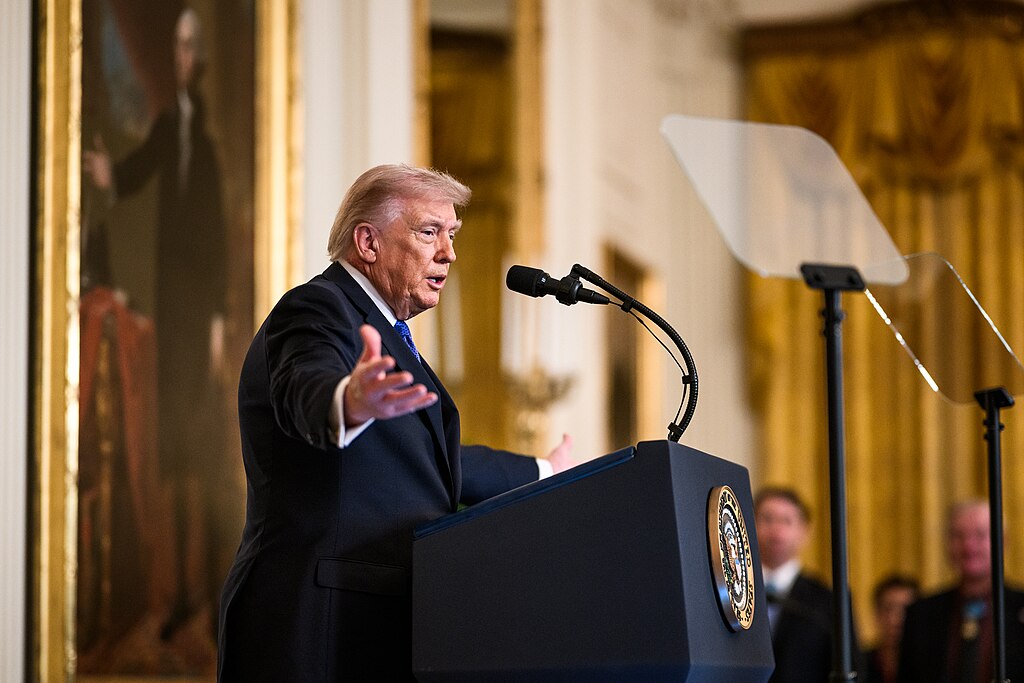
President Donald Trump signed a sweeping executive order Friday aimed at launching a major federal crackdown on cybercrime, online fraud, and international scam networks that officials say are costing Americans billions of dollars each year.
The move comes as cyber scams, ransomware attacks, and online fraud continue to surge across the United States — with many victims being older Americans and teenagers who are increasingly targeted by sophisticated criminals operating overseas.
According to a White House fact sheet, the order directs federal agencies to intensify their efforts against transnational criminal organizations responsible for large-scale scam operations targeting U.S. citizens.
Federal Government Targets Global Scam Networks
The executive order marks a shift in how Washington approaches online fraud.
Rather than treating cyber scams as isolated incidents, the administration wants law enforcement to treat them as organized international criminal enterprises.
Officials say many of these networks operate across multiple countries and rely on phishing attacks, ransomware, identity theft, financial fraud, and online extortion schemes.
Under the directive, federal agencies will now develop a coordinated plan to identify the criminal groups responsible for major cyber scams and determine new ways to disrupt and dismantle their operations.
The strategy will explore a wide range of tools the federal government can use, including:
- Criminal investigations and prosecutions
- Financial sanctions against cybercrime networks
- Diplomatic pressure on foreign governments
- Cybersecurity and intelligence operations
- New regulatory and enforcement actions
New National Cybercrime Task Force
The executive order also calls for the creation of a dedicated operational cell within the National Coordination Center to focus specifically on cybercrime intelligence and federal response efforts.
This new unit will coordinate information sharing across agencies and help track the criminal organizations responsible for large-scale digital scams.
Federal prosecutors have also been directed to place a higher priority on major cyber-related fraud cases and to pursue the strongest charges that can be supported by the evidence against those involved.
Meanwhile, the Department of Homeland Security will work with state and local officials to strengthen cybersecurity defenses across the country.
Plan To Return Stolen Money To Victims
Another key provision directs the Department of Justice to study whether seized assets from cybercriminals could be returned directly to victims.
For many Americans who lose savings to online fraud schemes, recovering stolen money has been extremely difficult. Officials say a new recovery program could help victims regain at least some of their losses.
Foreign Governments Could Face Pressure
Because many scam operations originate outside the United States, the order also focuses on the international dimension of cybercrime.
The State Department will be tasked with pressuring foreign governments to crack down on criminal networks operating within their borders.
Countries that fail to take action could face penalties including:
- Economic sanctions
- Visa restrictions
- Limits on foreign assistance
- Expulsion of officials connected to criminal activity
Officials say the goal is to disrupt what has become a global ecosystem of cybercrime targeting Americans.
Billions Lost To Online Scams
Federal data cited by the White House highlights just how widespread the problem has become.
Americans reported more than $12.5 billion in losses from cyber-enabled fraud in 2024 alone.
Surveys also show that roughly 73% of U.S. adults have encountered some form of online scam, cyberattack, or fraud attempt.
Authorities warn that criminals are becoming more sophisticated and are increasingly targeting vulnerable populations, including seniors.
Part Of Broader Cybersecurity Effort
The new directive builds on earlier cybersecurity initiatives launched during Trump’s second term.
Last June, the president signed another executive order designed to strengthen national cybersecurity and protect critical U.S. digital infrastructure from foreign cyber threats.
The administration has also supported bipartisan legislation addressing online exploitation, including the Take It Down Act, which targets the spread of nonconsensual intimate images and deepfake abuse.
With cybercrime continuing to expand worldwide, officials say the latest order represents a major step toward protecting Americans from increasingly sophisticated digital threats.
Leave a Reply
You must be logged in to post a comment.